Oil Price Forecast 2027: What the EIA Expects for Brent
The US Energy Information Administration expects Brent to average about $105 in the last quarter of 2026, then fall in 2027 as Gulf supply recovers. Here are the numbers and the risks behind them.
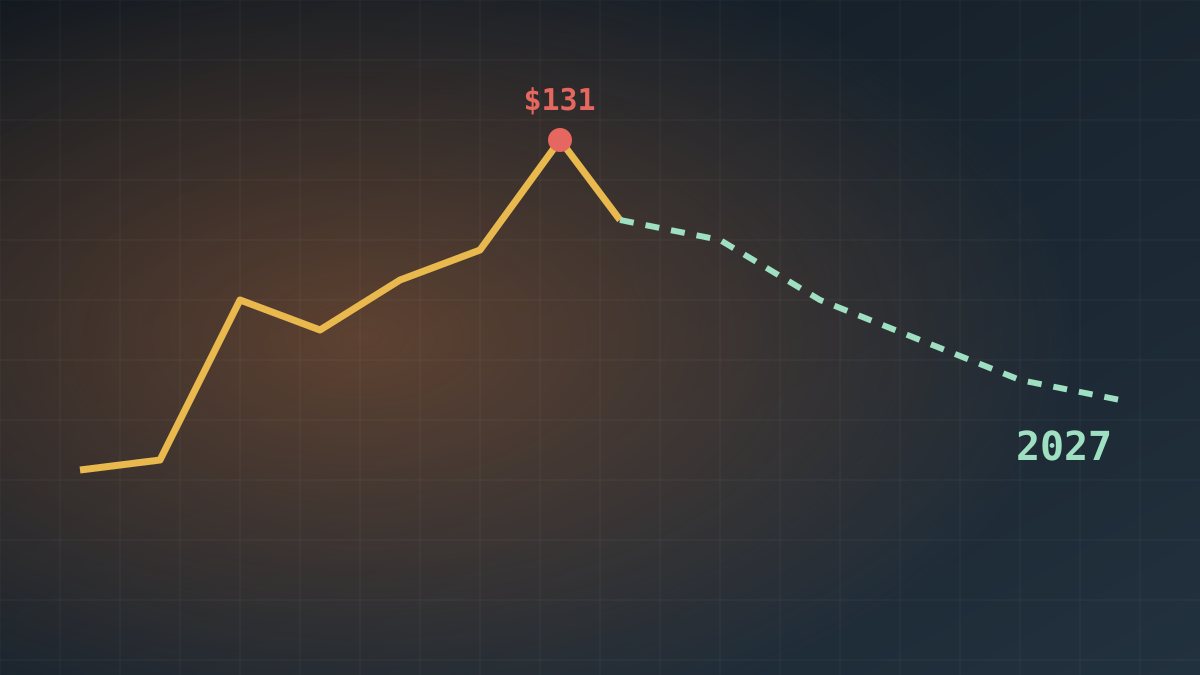
EIA forecast at a glance (October 2026)
- Brent average for 2026: about $96 a barrel.
- Fourth quarter of 2026: about $105.
- Average for 2027: about $84, falling to about $74 by the fourth quarter of 2027.
- The Brent spot price spiked to $131 on September 15, 2026, according to the EIA, after attacks halted flows on Saudi Arabia's East-West pipeline. Front-month futures peaked lower.
What the forecast assumes
The EIA publishes its Short-Term Energy Outlook every month. In October 2026 it assumed that oil flows from the Middle East stay constrained through the end of 2026, with about 4.5 million barrels a day shut in during the fourth quarter. It expects prices to ease in 2027 as output in the region recovers, bypass routes are used more and new UAE pipeline capacity comes online.
| Period | Brent forecast |
|---|---|
| 2026 average | ≈ $96/bbl |
| Q4 2026 | ≈ $105/bbl |
| Q2 2027 | ≈ $87/bbl |
| Q4 2027 | ≈ $74/bbl |
| 2027 average | ≈ $84/bbl |
For comparison, Brent traded around $72 before the war began in late February 2026.
Why prices could be higher
- Longer disruption in Hormuz: any delay in restoring safe passage keeps barrels off the market. See The Strait of Hormuz and Oil Prices.
- Attacks on bypass routes: the September spike showed how vulnerable pipelines and terminals are.
- Low emergency stocks: the US Strategic Petroleum Reserve is at its lowest level in decades, leaving less cushion.
- Shipping costs: record tanker rates and longer routes add to delivered prices.
Why prices could be lower
- A lasting agreement that reopens the strait fully and quickly.
- Weaker demand if high energy costs slow the global economy. See Recession Warning Signs.
- More supply from producers outside the Gulf, including US shale and OPEC+ members with spare capacity.
How reliable are oil forecasts?
Not very, especially in a crisis. The EIA itself warns that volatility will probably exceed what its forecast shows. Forecasts are best read as a central scenario that changes every month as events unfold. Futures prices, visible on our oil page, show what traders are willing to pay today for delivery months ahead, which is another useful reference.
What it means for you
If the forecast is right, gasoline prices should ease gradually in 2027 from their 2026 highs, with a lag of a few weeks behind crude. See Why Are Gas Prices So High in 2026? We will update this article when the EIA publishes new numbers.
This article is general education, not personalized financial advice. Read our editorial policy and disclaimer.